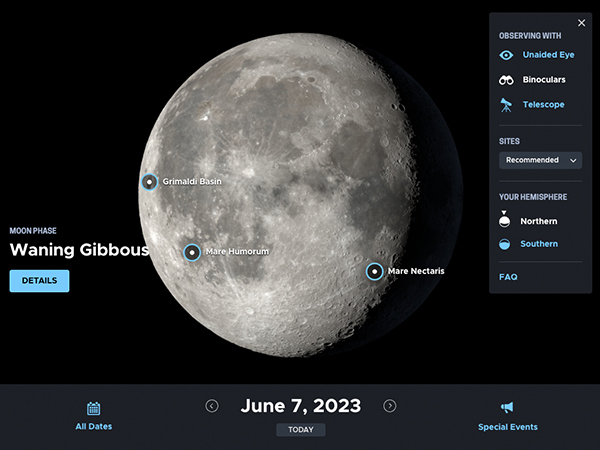
The Moon: Earth's Beautiful Nighttime Friend"
| Synonyms of Moon | Luna, Selene |
|---|---|
| Distance | distance of 384,400 |
| Diameter | diameter of 30 times in Earth days |
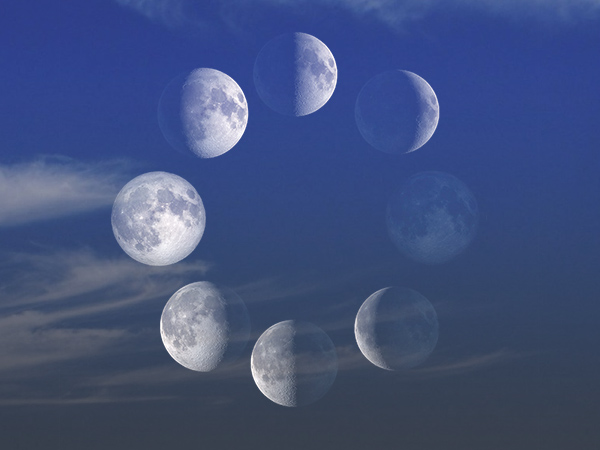
We always see the same side of the moon, because as the moon revolves around the Earth, the moon rotates so that the same side is always facing the Earth. But the moon still looks a little different every night. Sometimes the entire face glows brightly. Sometimes we can only see a thin crescent. Other times the moon seems to disappear entirely. As the bright parts of the moon appear to change shape during the month, each stage of the change is called a phase, and each phase carries its own name. This chart shows why this happens. The center ring shows the moon as it revolves around the Earth, as seen from above the north pole. Sunlight illuminates half the Earth and half the moon at all times. But as the moon orbits around the Earth, at some points in its orbit the sunlit part of the moon can be seen from the Earth, and at other points, we can only see the parts of the moon that are in shadow. The outer ring shows what we see on the Earth during each corresponding part of the moon's orbit.
Earth Rotation Around The Sun & Moon Rotation Around The Earth
How the Moon Got Its Name
Our moon shares a name with all moons simply because people didn't know other moons existed until Galileo Galilei discovered four moons orbiting Jupiter in 1610. In Latin, the Moon was called Luna, which is the main adjective for all things Moon-related: lunar.
Potential for Life
The many missions that have explored the Moon have found no evidence to suggest it has its own living things. However, the Moon could be the site of future colonization by humans. The discovery that the Moon harbors water ice, and that the highest concentrations occur within darkened craters at the poles, makes the Moon a little more hospitable for future human colonists.
Size and Distance
With a radius of about 1,080 miles (1,740 kilometers), the Moon is less than a third of the width of Earth. If Earth were the size of a nickel, the Moon would be about as big as a coffee bean. The Moon is an average of 238,855 miles (384,400 kilometers) away. That means 30 Earth-sized planets could fit in between Earth and the Moon. The Moon is slowly moving away from Earth, getting about an inch farther away each year.
Explore the Moon
Moon Phases
In our entire solar system, the only object that shines with its own light is the Sun. That light always beams onto Earth and Moon from the direction of the Sun, illuminating half of our planet in its orbit and reflecting off the surface of the Moon to create moonlight.
Moon Eclipses
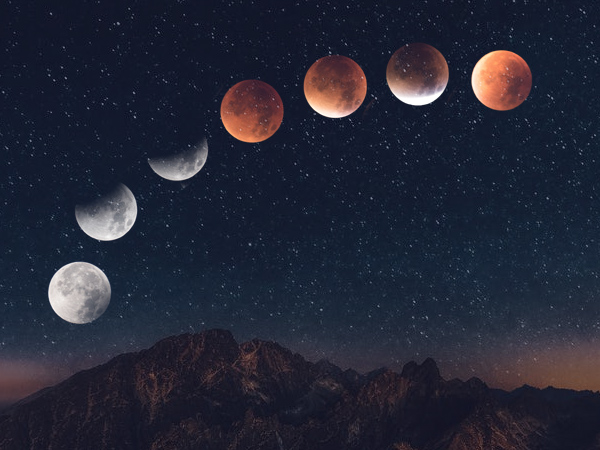
Lunar eclipses occur at the full moon phase. When Earth is positioned precisely between the Moon and Sun, Earth’s shadow falls upon the surface of the Moon, dimming it and sometimes turning the lunar surface a striking red over the course of a few hours.
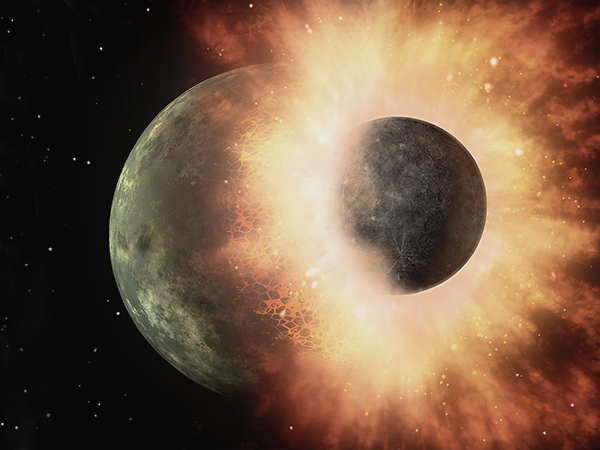
Moon Formation
Several theories about our Moon’s formation vie for dominance, but almost all share that point in common: near the time of the solar system’s formation, about 4.5 billion years ago, something ― perhaps a single object the size of Mars, perhaps a series of objects.
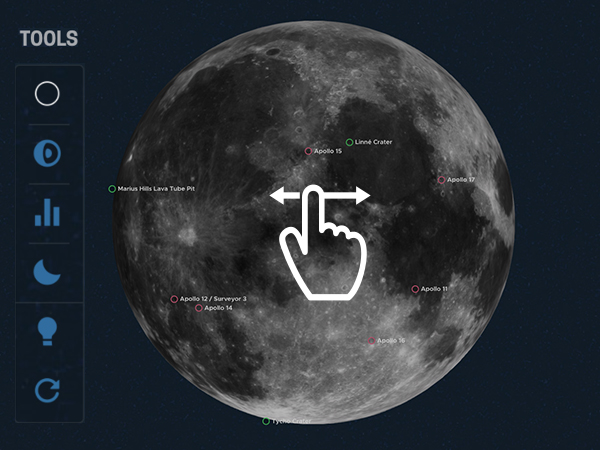
Interactives
Explore the Moon from your screen! The following interactive tools enable you to climb lunar mountains, investigate Apollo samples, and dig beneath the Moon’s surface.
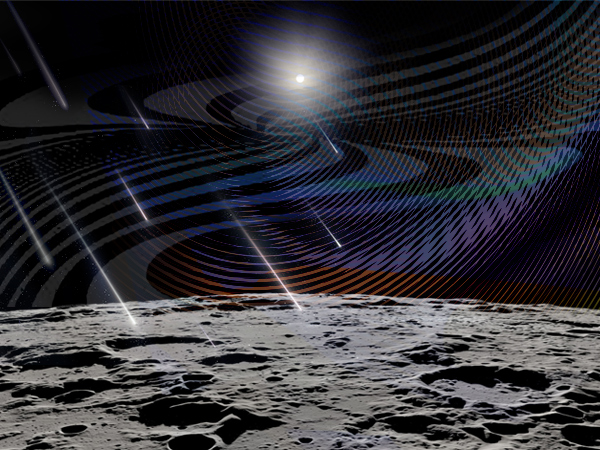
Weather on the Moon
On the Moon, snow does not fall. Thunder never rolls. No clouds form in the pitch-black sky. “Weather” on the Moon means something completely different than it does on Earth.
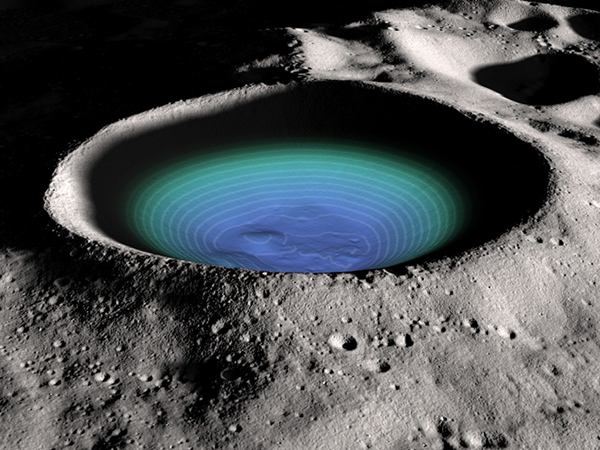
Water & Ices
What’s big, covered in water, yet 100 times drier than the Sahara Desert? It’s not a riddle, it’s the Moon! For centuries, astronomers debated whether water exists on Earth’s closest neighbor.
Moon Phase and Libration 2024
LUNAR LANDSCAPES
Malapert Massif
This massive mountain is also a candidate landing region for Artemis III, humanity’s return to the lunar surface.
Daily Moon Guide