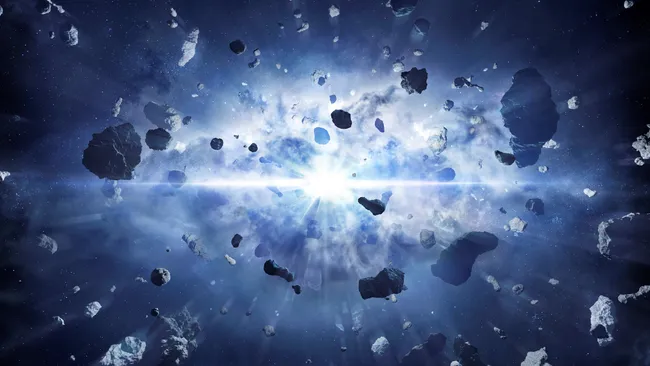
Big Bang Theory
he Big Bang Theory is the leading explanation for how the universe began. Simply put, it says the universe as we know it started with an infinitely hot and dense single point that inflated and stretched — first at unimaginable speeds, and then at a more measurable rate — over the next 13.7 billion years to the still-expanding cosmos that we know today. Existing technology doesn't yet allow astronomers to literally peer back at the universe's birth, much of what we understand about the Big Bang comes from mathematical formulas and models. Astronomers can, however, see the "echo" of the expansion through a phenomenon known as the cosmic microwave background. While the majority of the astronomical community accepts the theory, there are some theorists who have alternative explanations besides the Big Bang — such as eternal inflation or an oscillating universe.
The Birth Of The Universe
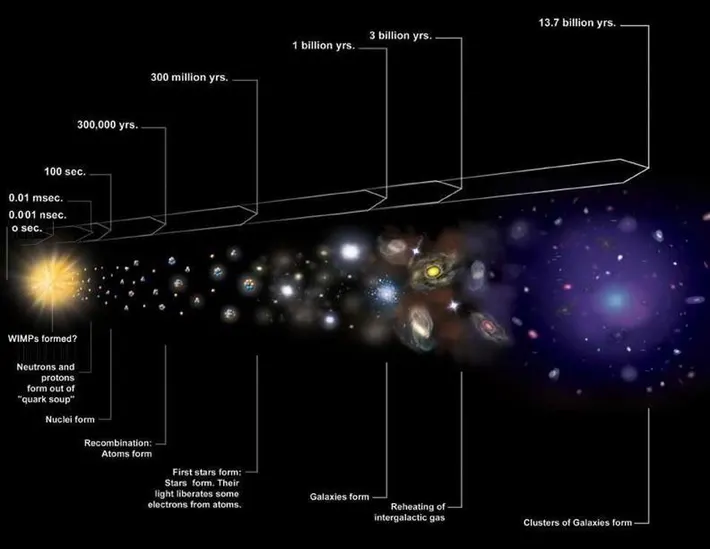
Around 13.7 billion years ago, everything in the entire universe was condensed in an infinitesimally small singularity, a point of infinite denseness and heat. Suddenly, an explosive expansion began, ballooning our universe outwards faster than the speed of light. This was a period of cosmic inflation that lasted mere fractions of a second — about 10^-32 of a second, according to physicist Alan Guth’s 1980 theory that changed the way we think about the Big Bang forever. When cosmic inflation came to a sudden and still-mysterious end, the more classic descriptions of the Big Bang took hold. A flood of matter and radiation, known as "reheating," began populating our universe with the stuff we know today: particles, atoms, the stuff that would become stars and galaxies and so on.

Jason Steffens
Assistant Professor
Jason Steffens is an assistant professor of physics and astronomy at the University of Nevada, Las Vegas.
Has the Big Bang Theory been proven?
This isn't really a statement that we can make in general. The best we can do is say that there is strong evidence for the Big Bang Theory and that every test we throw at it comes back in support of the theory. Mathematicians prove things, but scientists can only say that the evidence supports a theory with some degree of confidence that is always less than 100%. So, a short answer to a slightly different question is that all of the observational evidence that we've gathered is consistent with the predictions of the Big Bang Theory. The three most important observations are: 1) The Hubble Law shows that distant objects are receding from us at a rate proportional to their distance — which occurs when there is uniform expansion in all directions. This implies a history where everything was closer together. 2) The properties of the cosmic microwave background radiation (CMB). This shows that the universe went through a transition from an ionized gas (a plasma) and a neutral gas. Such a transition implies a hot, dense early universe that cooled as it expanded. This transition happened after about 400,000 years following the Big Bang. 3) The relative abundances of light elements (He-4, He-3, Li-7, and Deuterium). These were formed during the era of Big Bang Nucleosynthesis (BBN) in the first few minutes after the Big Bang. Their abundances show that the universe was really hot and really dense in the past (as opposed to the conditions when the CMB was formed, which was just regular hot and dense — there's about a factor of a million difference in temperature between when BBN occurred and when the CMB occurred).